My Store
Desi Arhar Dal (Toor Dal) from Pawai, Hamirpur – Unpolished Native Heirloom | Organic Sudha
Desi Arhar Dal (Toor Dal) from Pawai, Hamirpur – Unpolished Native Heirloom | Organic Sudha
Couldn't load pickup availability
Small, dull-gold, and slow. Native pigeon pea from Pawai village in Hamirpur, grown through nine months on unirrigated kabar soil, unpolished and split on a stone chakki. It costs more than market toor and it doesn't look as pretty. Here's exactly why.
At a glance
- Village: Pawai, Hamirpur district, Uttar Pradesh
- Grown by: Two farming families
- Soil: Kabar (medium-black clay)
- Season: Sown July, harvested April
- Irrigation: None — entirely rainfed
- Processing: Stone chakki split, hand-cleaned, small batch
Where it comes from
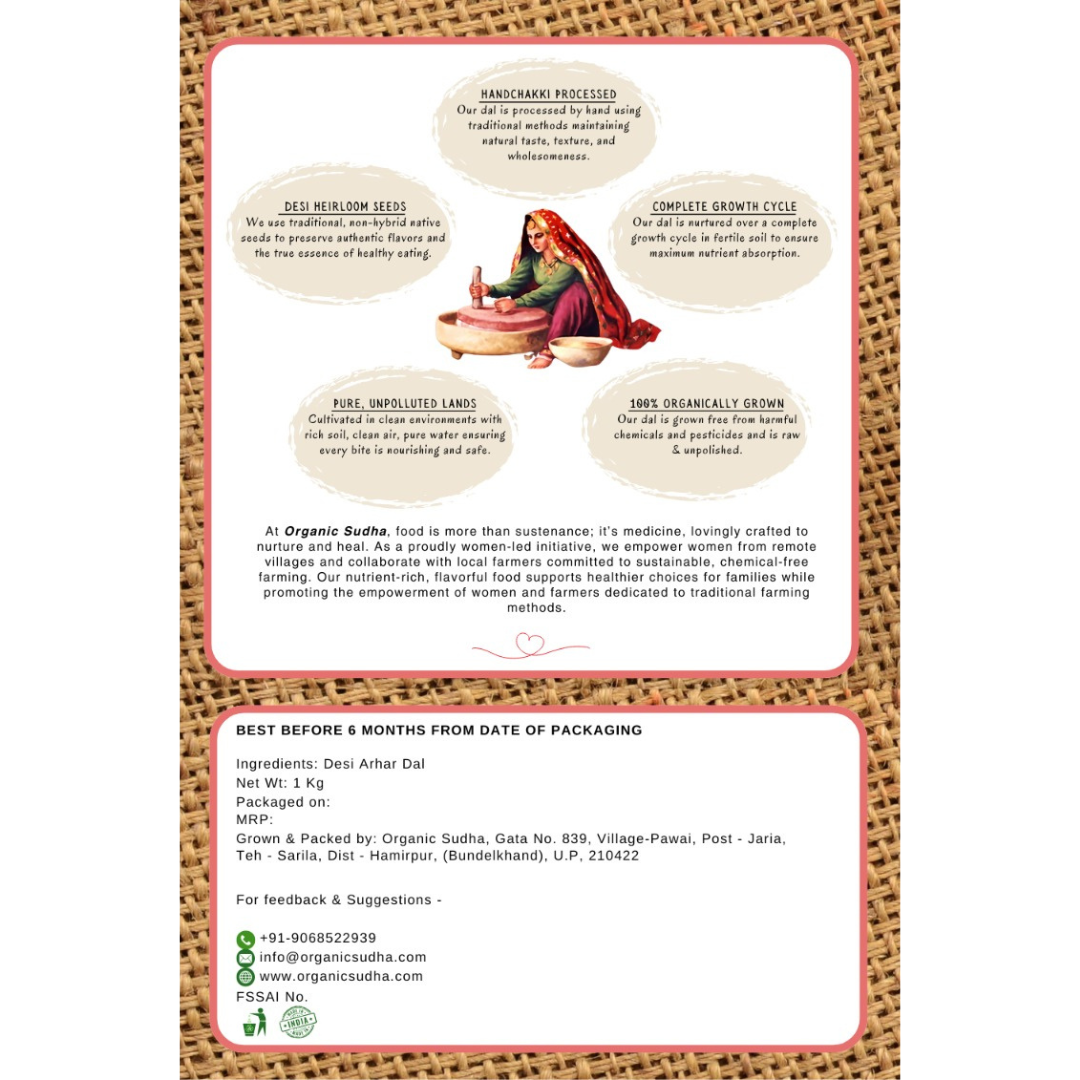
Arhar here is a long crop. It goes into the ground in July, with the monsoon, and doesn't come off until April — nine months standing in the field on kabar soil in Pawai, Hamirpur district, with no irrigation at any point.
Kabar is the medium-black clay soil of Bundelkhand. It holds water tightly through the dry months, which is exactly what a crop standing from July to spring needs. Arhar sends its roots deep and draws on what the clay has kept, long after the surface has gone hard and cracked.
Nine months in the field, and not one drop of irrigation.
That length is the whole story. Short-duration commercial toor, grown under irrigation and turned around fast, never has to work for its water. What you get from a long season on hard ground is a smaller grain carrying far less water and far more of everything else — which is why it tastes stronger, and why less of it goes further in the pot.
It also means the farmer gets one crop a year where an irrigated farmer gets two or three. That's a real part of what you're paying for.
Two farming families in Pawai grow the arhar we sell. That's the whole supply. When their harvest is finished, we're out of stock until the next one.
What makes it different
- Native seed, saved and re-sown by the families who grow it, not purchased hybrid
- Nine months in the field, unirrigated — sown July, harvested April
- Small, compact grain — dense rather than swollen with water
- Completely unpolished. Market toor dal is very commonly polished with water, oil or leather polish to give it that uniform glossy yellow. Ours is matte, uneven, dull gold.
- Stone-chakki split in small batches, not high-speed milled
- Hand-cleaned, not machine-graded
- Chemical-free from sowing through storage — no fumigants in the godown either
How it tastes and cooks
- The aroma is strong and earthy the moment it hits hot water. Commercial toor is comparatively neutral.
- It takes noticeably longer to cook — expect 30–40% more time than polished market toor. Dense grain, no polishing to strip the outer layer.
- It thickens more with less dal. Use about ¾ of what you normally would. People routinely overshoot the first time and end up with dal thick enough to stand a spoon in.
- It holds a little texture rather than going completely smooth, unless you cook it well past the point you're used to or whisk it.
- The cooked colour is deeper — more amber than pale yellow.
- It froths while boiling. Unpolished dal does.
How to cook it
- Soak: 2–3 hours, or overnight
- Pressure cooker: 6–8 whistles on medium, soaked
- Open pot: 50–60 minutes, soaked
- Water ratio: 1 : 3
- Quantity: ¾ of your usual
Rinse, soak, pressure cook with turmeric and salt. Whisk briefly if you want it smoother. Tadka of ghee, jeera, hing, garlic and dried red chilli. Go lighter on the masala than you would with market toor — this dal has its own flavour, and heavy spicing buries what you paid for.
The way it's cooked in Pawai
In Bundelkhand this dal is cooked in an earthen pot over a chulha, and if you have ever eaten it that way you already know it doesn't taste the same from a steel pan.
The reason is the heat. A chulha gives low, wide, even heat rather than a concentrated flame, and an earthen pot holds it and releases it slowly. The dal comes up to temperature gradually and stays there a long time, so it breaks down properly instead of being forced. The unglazed clay is slightly porous, so a little moisture moves through the walls and the dal thickens by reduction rather than by boiling hard. It comes out rounder, softer, less sharp.
If you want to try it at home: cook the dal in a clay handi over your lowest flame, on a tawa or heat diffuser so the pot doesn't sit directly on the fire. Season a new clay pot first — soak it in water overnight, then rub the inside with oil and heat it gently a few times before cooking in it. It takes far longer than a pressure cooker. It is also the only way to taste what this dal was actually bred for.
Nutrition
Per 100 g, uncooked:
| Energy | 331 kcal |
| Protein | 21.7 g |
| Carbohydrate | 55.2 g |
| of which sugars | 2.1 g |
| Fat | 1.6 g |
| Dietary fibre | 9.1 g |
| Iron | 3.90 mg |
| Potassium | 855 mg |
| Phosphorus | 271 mg |
| Calcium | 71.7 mg |
High in protein and high in dietary fibre. No added preservatives, colours or polishing agents.
Approximate values, based on standard composition data for arhar dal.
Storage
Airtight, cool, dry, away from sunlight. Best within 6 months.
Worth saying plainly: commercial dal often stays insect-free in storage because it has been fumigated or polish-coated. Ours hasn't been, so treat it like real food. Dried neem leaves or two or three dried red chillies in the container is the traditional method and it works. Refrigerate if you're somewhere humid and buying a large pack.
What to expect
We'd rather tell you now than have you surprised.
- It costs more than market toor. A long unirrigated season, native seed, hand-cleaning and stone-chakki milling all cost more per kilo — and the families who grow it get one harvest a year instead of two or three.
- It doesn't look as good. Dull, matte, uneven in size and colour. Glossy uniform toor is polished toor.
- It takes longer to cook. Plan for it.
- Use less than you think — ¾ of your usual quantity.
- The occasional stone or husk fragment. Hand-cleaned, not machine-polished. Rinse before cooking.
- It goes out of stock. Two families, one harvest a year. When it's finished we say so rather than filling the gap with bought-in stock.
Questions
Why does it cost more than the toor dal in the market?
A long rainfed season means one harvest a year instead of two or three. Native seed rather than high-yield hybrid means lower yield per acre. Hand-cleaning and stone-chakki milling instead of an industrial line. And we buy direct from the two families who grow it, at a price that makes growing it worth their while.
Why is it smaller and duller than market toor?
Smaller because it's a native variety grown without irrigation — less water in the grain. Duller because it isn't polished. Market toor's uniform gloss usually comes from treatment with water, oil, or leather polish.
Is polished dal actually a problem?
Polishing adds nothing nutritionally and strips the outer layer. Leather polish in particular is something a lot of people would rather not eat. Ours is untreated, which is why it looks the way it does.
Why does my dal come out too thick?
You've used too much. This dal thickens more than commercial toor. Start at ¾ of your usual quantity.
Why does it froth while boiling?
Natural saponins that polishing strips away. Harmless — skim it or ignore it.
Does it need soaking?
Strongly recommended. Two to three hours, or overnight.
Where exactly does it come from?
Pawai village in Hamirpur district, Uttar Pradesh, from two farming families. Sown in July on kabar soil, harvested in April, grown without irrigation.
Is it organic?
It's grown without synthetic fertiliser or pesticide, and not fumigated in storage. We are not yet certified — PGS-India certification is in progress, and we'll show the certificate here when we have it.
Testing and certification
- FSSAI Licence No. 12725018000079
- Organic certification: PGS-India — in progress
- Lab testing: not yet available. We'll publish a residue report here once we have one.